From Arcade Flight Games to Modern Interactive Entertainment
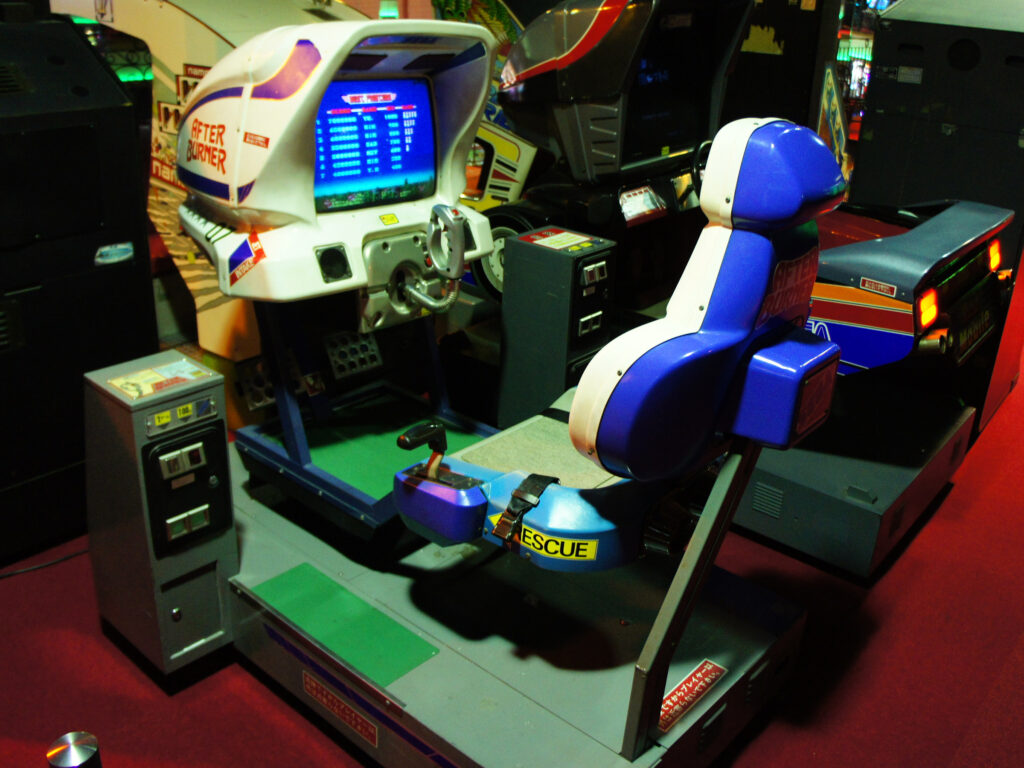

For many people, the first experience of a virtual cockpit was not a professional training facility but an arcade cabinet or a home computer. A screen, a set of controls and a fictional environment offered a way to explore flight as entertainment. That experience differed from aviation training in purpose and in design. It also became part of a broader cultural history of interactive entertainment, in which the physical machine, the software and the audience evolved together.
Aviation as an arcade theme
Flight has long been a recognizable subject for popular entertainment. The appeal is easy to understand: a cockpit provides an unusual point of view, movement through a landscape creates a sense of scale, and the idea of controlling a vehicle gives the player a clear relationship to the action. A game can communicate these ideas without modeling the full complexity of a real aircraft.
The arcade was especially well suited to this kind of recognizable theme. A dedicated cabinet could use physical controls and visual design to tell a prospective player what sort of activity to expect. Some machines emphasized the feeling of sitting inside a vehicle rather than standing in front of an ordinary screen. The cabinet became part of the fictional environment, even though the entire experience was created for play.
The arcade cockpit of the 1980s
Sega’s After Burner series offers a historical example of the arcade flight theme. The Museum of the Game documents After Burner and After Burner II as 1987 releases. The titles used the imagery of jet flight in an arcade game rather than a professional instruction program. Variations in cabinet design included specialized controls and seated configurations.
The attraction of such machines was not primarily the accuracy of an aviation model. Their design emphasized immediate visual movement, a recognizable control relationship and the distinctive physical presence of the cabinet. Players could understand the broad premise quickly without studying the procedures required for operating a real aircraft. That difference between a themed experience and a training device is central to understanding the genre.
The broader arcade landscape contained many other subjects and interaction styles. The Strong National Museum of Play’s Video Game History Timeline places arcade releases within the history of video games, alongside console and computer developments. Flight games were a part of that changing landscape, not the sole origin of interactive entertainment.
When the experience moved into the home
Personal computers and consoles changed the relationship between a player and a game. A dedicated arcade machine was tied to a particular location, whereas a home device could run many different programs. Players could return to a virtual environment over a longer period and choose when to engage with it. Hardware manufacturers could also offer accessories that gave particular genres distinctive controls.
Flight simulation software represented one path through this change. The Computer History Museum’s profile of Bruce Artwick documents his contributions to Flight Simulator and Microsoft Flight Simulator. These products demonstrate how a flight-themed program could become a sustained home computing activity. Other games continued to favor the rapid pace and clear objectives associated with the arcade.
The difference was not simply that home software was more realistic. The environment of use changed. A person playing at home might have time to read instructions or explore a setting without a fixed session length. A person approaching an arcade cabinet might expect to understand the activity immediately. These expectations shaped the interface, pacing and structure of the games themselves.
From dedicated cabinets to general-purpose devices
The arcade cabinet combined a display, computer hardware and input controls into one physical object. A general-purpose computer separated those elements to some extent. A developer could distribute new software without building a new cabinet for each program, and a player could choose between experiences using the same display and input devices. The change opened space for many genres that did not benefit from a large specialized machine.
Later, online distribution and browser technology offered additional ways for games to reach an audience. Browser-based games may be delivered through a web page and use standard device inputs, depending on their design. A compatible device can host a range of experiences, from small puzzles and interactive stories to more elaborate simulations. MDN’s introduction to web game development describes the technical building blocks available for developing these kinds of web experiences.
The move away from a dedicated cabinet did not mean the disappearance of physical controls. Enthusiasts still build simulation setups with specialized accessories. The significance of the change is the range of possible settings: a person can choose between a specialized installation and a more portable, general-purpose interface.
What arcade design still teaches
An arcade machine had to communicate its identity rapidly. That need encouraged strong visual themes and clear interactions. Contemporary interactive entertainment faces related questions when introducing a new user to an application. Does the interface explain what can be done? Is the experience understandable without lengthy preparation? Does the design give the participant useful feedback?
Those questions apply across different styles of digital games. A simple activity may benefit from immediate instructions; a more involved simulation may require a gradual introduction to its controls. The right approach depends on the intended audience, not on an assumption that all games should reproduce the structure of an arcade session.
Modern digital entertainment also encompasses activities that bear little relationship to aviation. This variety is evidence of the flexibility of computing as a medium, not evidence that those activities share a direct historical connection with flight simulation. For a wider look at how the medium developed, see the evolution of digital games from simulation to entertainment.
A history worth preserving
The physical arcade cabinet remains interesting as an artifact because it shows how a particular generation of designers imagined the relationship between technology and the player. Photographs of surviving machines, museum records and software histories help document a period when the shape of the machine itself often expressed the subject of the game.
The progression from specialized flight-themed cabinets to home computers and portable devices illustrates the changing conditions of digital play. Aviation was one recognizable theme through which developers explored the possibilities of computer-generated movement and interactive control. The larger story is how people came to experience a responsive digital environment in many different places, using many different kinds of interface.
The physical setting and the social experience
An arcade is also a public environment. Other people can see a cabinet, observe someone playing or discuss the machine while waiting nearby. That setting differs from the experience of using a home simulator alone, even if the two activities share a similar visual theme. The social context can influence how a game introduces itself, how a session begins and ends, and how easily an observer can understand what is happening. Modern digital entertainment can reproduce some forms of shared participation through networked features, but a connection between devices is not the same as sharing a physical room. Some experiences deliberately preserve local interaction, while others emphasize individual exploration or communication across distance. The change in setting is therefore as significant as the change in screen technology. Looking at arcade photographs and surviving cabinets helps readers recognize that interaction was once designed around a particular piece of furniture and a particular public space. That material history is easy to miss when the same software is encountered only through a contemporary display. The arcade flight cabinet remains a useful example of entertainment design shaped by both a digital program and a physical environment.
Featured photograph: Sega Afterburner.jpg — 空練 / Wikimedia Commons; CC BY-SA 3.0. Display may be resized or cropped.