From Aviation Simulators to the Evolution of Computer Games
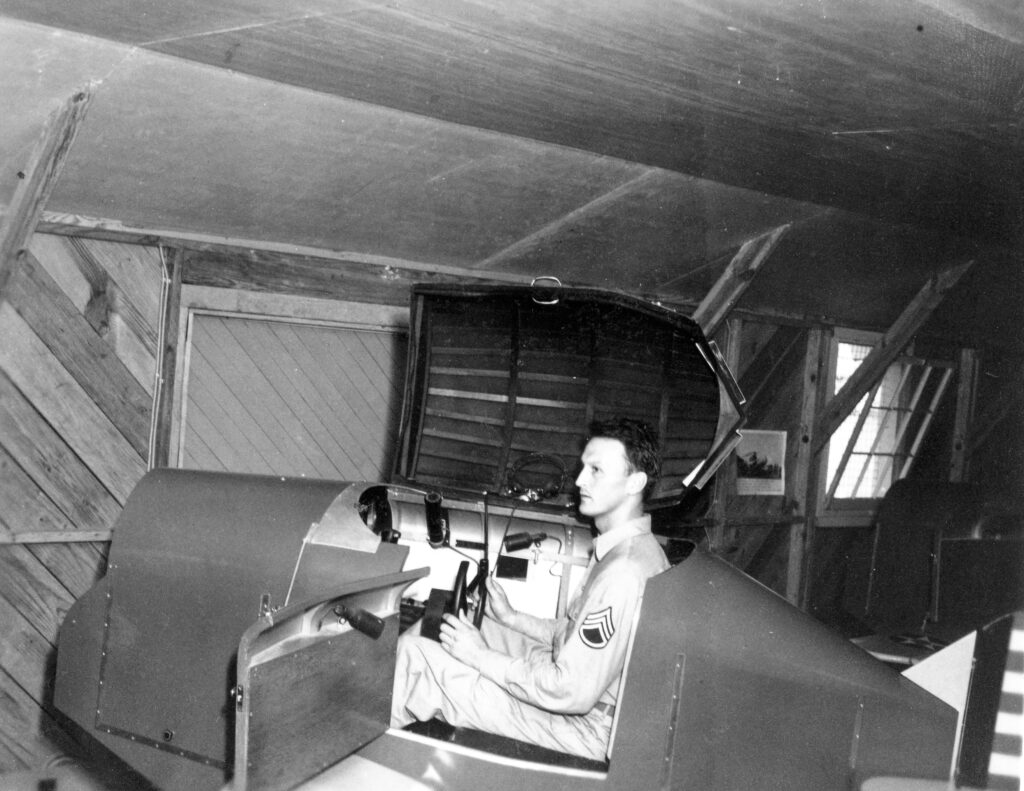

Before a flight game could fit on a home computer, aviation had already confronted a difficult design problem: how to recreate the experience of controlling a machine without putting that machine in the air. The answers changed as mechanical systems, electronics and computer graphics developed. The history is not a simple story in which every video game descended from flight training. It is a meeting of two traditions: building useful models of physical systems and creating interactive experiences for their own sake.
A cockpit without an aircraft
Edwin Link’s mechanical trainer is one of the best-known early examples of aviation simulation. The Smithsonian’s historical account of pilot training traces the trainer’s debut to 1929 and explains its role in instrument training. Its enclosed cockpit and responsive instruments allowed people to practice a particular kind of task away from a real aircraft. The important innovation was not an exact replica of the world but an environment in which a human input produced an observable consequence.
A trainer could concentrate on selected tasks instead of reproducing every sensation of flight. This distinction is important when considering its relationship to games. A historical training device is not a video game simply because it responds to a person. Yet both types of system depend on the design of controls, the presentation of feedback and a set of rules that govern what can happen next. Those shared principles became more visible when computers began to represent motion on screens.
When computation became a visible activity
Early computers were expensive research and institutional equipment. Displays and input devices gave some systems capabilities that went beyond producing a printed numerical result. A program could use a mathematical representation of motion and convert it into a changing visual display. The person at the controls could influence the next state of that representation.
The Computer History Museum’s Spacewar! history documents Spacewar!, an early interactive computer game developed for the PDP-1 in the early 1960s. Its moving spacecraft demonstrate the appeal of a rule-based environment that reacts to input. Spacewar! was not a conventional aviation trainer, and its fictional environment should not be confused with aeronautical engineering. Nevertheless, it offers a useful example of how mathematical motion and graphical interaction could become the substance of entertainment rather than merely a way to illustrate a calculation.
The home computer changes the audience
The spread of personal computers created opportunities for software that would have been impractical for an ordinary household in an earlier era. A flight simulation could now be distributed as a program rather than as a room-sized installation. The relationship between the user and the system changed as well. A home user could explore a simulated setting out of curiosity rather than participate in a prescribed training session.
The career of Bruce Artwick provides a particularly direct connection between aviation simulation and computer entertainment. The Computer History Museum profile of Artwick identifies his work on Flight Simulator and Microsoft Flight Simulator, alongside other simulation products. These programs helped establish flight as a recognizable subject for personal computer software. Their appeal could involve navigation, learning a control scheme or simply seeing a virtual environment from a perspective not readily available in everyday life.
Early personal computers had limited processing power and memory. A developer had to decide which details to represent and which to leave out. A simple horizon, a few landmarks or an instrument panel could communicate enough information to create an understandable experience. Technical limitations therefore encouraged a form of design in which visual economy mattered. More detail was not automatically more useful if the machine could not update that detail at a reasonable rate.
Two approaches to the same subject
Flight software developed in more than one direction. Some products emphasized the sustained experience of operating a modeled aircraft. Others emphasized short challenges, recognizable objectives and rapid changes in the environment. An arcade title could reduce a flight experience to a handful of controls and a short session, while desktop software could offer a much longer journey. Both borrowed aviation imagery, but their definitions of success were different.
This divergence helps explain why the word simulator has different meanings in different contexts. Professional devices have particular intended uses, and certain training devices must meet defined requirements. Entertainment software is evaluated primarily through the experience it offers its audience. A convincing virtual landscape or an elaborate controller is not proof that software is suitable for real-world instruction. See our discussion of professional and recreational flight simulation for the distinction between the two settings.
What later games inherited from simulation
The shared contribution of simulation and interactive graphics extends beyond flight. A racing game can represent vehicle momentum; a management game can represent changing resources; a strategy game can model a network of competing decisions. The model does not have to reproduce a real object faithfully to make the experience understandable. It needs consistent relationships between decisions and consequences.
This also explains why abstractions remain valuable even as computers become more powerful. A map with clear symbols can communicate a location more effectively than a realistic but visually crowded scene. A simple representation of acceleration can be more satisfying in a short game than a detailed model that obscures what the player is supposed to do. Designers continually negotiate between fidelity, clarity and the time available to the audience.
The relationship between entertainment and computing is documented more broadly in the Computer History Museum’s graphics and games timeline. Aviation simulation is one strand in this wider history, alongside research graphics, arcade machines and household computers. It demonstrates how the same tools can be directed toward different outcomes.
A continuing cultural connection
Today, dedicated home simulation setups can involve screens, physical controls and accessories, while simpler games can be played with a keyboard or touchscreen. The common ground is not the hardware alone. It is the opportunity to enter a responsive environment, test an idea and observe the result.
Looking back at the mechanical trainer and the early computer game makes that continuity easier to see. A machine once built to teach a particular skill and a program built to entertain represent different uses of interactive technology. Their histories intersect without becoming interchangeable. That intersection is one reason aviation remains such an enduring subject in computer game culture.
Preserving the early software record
A historical account of home simulation can be difficult to reconstruct from screenshots alone. The visible scene records what the program displayed at a particular moment, but it does not reveal how quickly the scene changed, which controls were available, or how the software responded to input. Manuals and surviving hardware can supply some of that missing context. Museum collections are especially useful because they preserve the relationship between a program and the kind of computer on which it originally ran. An emulator may allow a modern reader to experience an older title, but the modern display, input device and processing environment can change the experience. These distinctions matter when comparing early flight programs with later software. It is easy to judge an early wireframe scene by the standards of a contemporary game and overlook the achievement of making it responsive on the equipment of its time. A more informative comparison asks what the system made possible for its original audience and which design choices continued to be useful as technology improved. This approach also keeps the history grounded in surviving objects and records rather than in a retrospective claim that all modern games followed one technological path.
Featured photograph: LinkTrainerSeymourIndiana.jpg — Unknown U.S. Army photographer / Wikimedia Commons; Public domain in the United States. Display may be resized or cropped.