The Evolution of Digital Games: From Simulation to Entertainment

In October 1958, visitors to an open day at Brookhaven National Laboratory on Long Island found an unusual exhibit. Physicist William Higinbotham had wired an analogue computer to a small oscilloscope screen. A bright dot bounced over a line that stood in for a net. Two people could hit it back and forth with handheld controllers. He called it Tennis for Two. Visitors lined up to play it, which for a lab open day full of serious science exhibits says a great deal.
What makes that story interesting for anyone who cares about simulation is how little it copied. There was no court, no racket and no player on screen. Yet the dot followed a curved path, as if gravity were pulling it down, and you had to time your shot. People didn’t need realism. They needed decisions that mattered and a screen that answered back.
That idea runs through the whole history of digital games. Simulation is one road into it, and an important one for aviation. But play has always been broader than copying the physical world.
When a model becomes a toy
A computer model represents chosen relationships. Speed and distance, thrust and altitude, wind and drift. On its own, a model is a set of equations. Hook it up to a screen and some controls, though, and it turns into a space for trying things out.
Play shows up when the rules and feedback are designed around what the person at the controls finds interesting. In 1962, students at MIT wrote Spacewar! for a PDP-1, a room-sized computer worth a fortune. Two ships circled a star, firing at each other while gravity pulled them inward. It was partly a demonstration of what the machine could do. It was also, very obviously, fun. The Computer History Museum traces this long relationship between computers and games, and it’s a story of many overlapping experiments, not one great invention.
Aviation makes the point especially clearly. The same basic flight model can serve very different purposes. In one setting it demonstrates how lift works. In another it trains a pilot to handle an emergency. In a third, it lets someone fly over their own house just for the pleasure of it. In 1969 a high school student named Jim Storer wrote a text program in which you tried to land a spacecraft on the Moon by typing in how much fuel to burn each second. A decade later Atari turned the same idea into the Lunar Lander arcade game. Same physics, very different experience. Our piece on the history of aviation simulators and computer games follows that crossover in more depth.
The goal of a product shapes how it presents itself. Games often simplify controls, shorten flights or invent whole new settings, because their job is to be enjoyable, not to prepare someone for a checkride.
Where people played changed what they played
Arcades offered machines built for one game. They had special controls, short sessions and a steady turnover of players. The cabinet itself was part of the attraction, painted and lit to draw people across a room. Designs that worked there had to be learnable in seconds and over in a few minutes.
Home computers and consoles changed that. Players could spend hours on a single game, at their own pace, in a familiar chair. Some games kept the quick, arcade-style rhythm. Others stretched out into long campaigns or open worlds with no fixed ending at all.
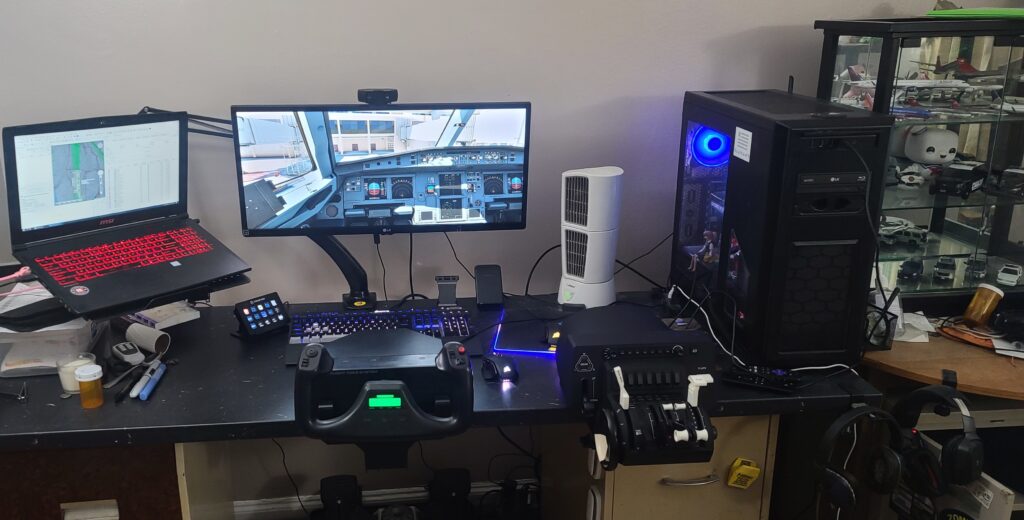
Home flight simulation took off in exactly that setting. Bruce Artwick’s company subLOGIC released a flight simulator for the Apple II around 1980, with wireframe graphics that look almost abstract today. Microsoft licensed it soon after, and the series that grew from it has been running in one form or another ever since. The Strong National Museum of Play’s Video Game History Timeline gives a broad sense of how these developments fit together across the decades.
Where a game is played still affects how it’s built. It shapes the menus, the difficulty, how instructions are given and how progress is shown.
One screen, many worlds
As graphics improved, a single machine could show a cockpit in the morning, a battlefield map at lunch and a falling-block puzzle at night. That flexibility let designers invent rule systems that had no connection to the physical world at all.
Greater detail didn’t kill off simple games, though. A plain display can keep the rules crystal clear. Detailed graphics can build atmosphere or help a player make sense of a busy scene. Neither approach is better in itself. Tetris, which first appeared on a Soviet computer in 1984, needed nothing but coloured blocks to become one of the most played games in history.
Simulation itself kept turning into play in unexpected ways. In 1989 Will Wright’s SimCity let players run a city’s zoning, power and traffic. It had no way to win. Wright called it a software toy, and players loved poking at its model to see what would happen if they built a stadium next to a power plant. It was a simulation, but nobody was training for anything. They were just curious.
The browser becomes a place to play
Web browsers opened another door. Suddenly people could try a small game without installing anything. You clicked a link, and seconds later you were playing.
Early browser games relied on plugins, and they often felt fragile. Modern web standards changed that by building graphics, sound and input support directly into the browser. Mozilla’s introduction to web game development explains how those pieces fit together, and it’s a good read for anyone curious about how games for web browsers are actually built.
Today browser games cover a huge range. Puzzles, classroom activities, multiplayer matches, interactive stories and simulations all run in a tab. There are even free flight simulators that work entirely in a browser, letting a curious student take off from a virtual runway on a school laptop. How a game is delivered affects practical limits like loading time, which devices it works on and what controls are available. It doesn’t decide what the game is about.
Phones and tablets added their own challenges. A touchscreen has no buttons to feel for and no joystick to grip. Designers have had to rethink controls, make targets larger and change the pace of play to fit how people actually hold and use their devices.
Fun means different things to different people
Entertainment isn’t a single goal. Some people play to solve problems. Some want to compete, some want to build things, and some just want to wander around a world and see what’s there. A few play mainly to talk to friends.
A game inspired by a real system may only represent the parts that serve its purpose. A combat flight game might get the feel of a dogfight right while ignoring fuel planning entirely. A relaxing navigation game might skip the radio calls. That’s fine, as long as nobody mistakes it for training. Neither a fantasy setting nor a beautifully detailed cockpit replaces professional instruction.
That’s also why plain, honest descriptions matter. Saying clearly what an app does and doesn’t do is far more useful than sweeping claims that it will “make you a better pilot” or “sharpen your brain.”
Finding and choosing a game
How people choose games has changed too. Boxed software meant a trip to a shop, a decision and an installation that might take an afternoon. Web games are often just a link someone sent you.
That ease is welcome, but it puts more weight on clear information. A good game description should say what you’ll need before you start, whether that’s an internet connection, a particular browser or an optional controller. Few things are more frustrating than discovering halfway through that a game needs a joystick you don’t own.
It’s also worth dropping a couple of assumptions. Browser games aren’t automatically smaller or simpler than installed ones. And installed games aren’t automatically more realistic. How a game is delivered, how big it is and how accurately it models anything are three separate choices.
The questions that don’t change
The move from rare, specialised machines to software almost anyone can open has widened play enormously. Yet the core questions have stayed much the same since Higinbotham’s dot first bounced across that oscilloscope. Can players understand what’s happening? Do the controls behave predictably? And does the experience suit the person playing and the place they’re playing it?
Answer those well, and the technology almost stops mattering. A bouncing dot on a tiny screen was enough to make people queue in 1958. The tools are vastly more powerful now. The basic test is exactly the same.